Why Does AI Recommend Websites Instead of Social Media Posts?
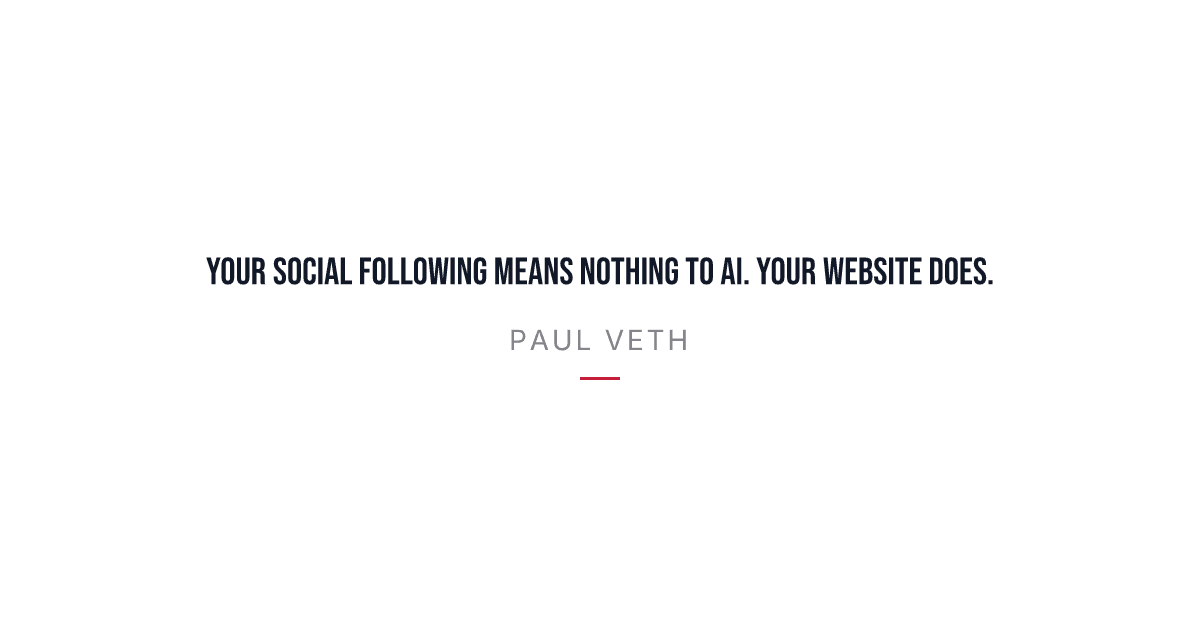
AI systems index structured web content, not social posts. Experts with owned websites get cited 4-6x more often than those building on social platforms.
What Is the Real Risk of Building Your Brand on Social Media?
Social platforms control your reach, your audience, and your visibility. One algorithm change can erase years of audience building with no warning.
LinkedIn, Instagram, and every other platform make one thing clear in their terms of service: they own the relationship with your audience. You rent attention. The moment the algorithm shifts, that attention disappears. Experts who have built their entire marketing presence on social media are one platform update away from starting over.
This is not a hypothetical risk. It has happened repeatedly across every major platform. Organic reach on Facebook collapsed from over 16% in 2012 to under 2% by 2014, according to data published by Social@Ogilvy. Instagram followed a similar trajectory. LinkedIn engagement has become increasingly pay-to-play for anyone trying to reach beyond their immediate network.
The deeper issue is structural. Social platforms are designed to keep users inside the platform. They actively suppress outbound links to reduce click-through to external sites. Every post you publish lives inside a walled garden that benefits the platform, not you. Your content builds equity for the platform, not for your own digital presence.
How Do AI Systems Find and Recommend Experts?
AI systems crawl websites, read structured data, and index expertise through accessible web content. They do not index Instagram reels or LinkedIn posts as authoritative sources.
When someone asks ChatGPT, Perplexity, or Google's AI Overviews for an expert in a specific domain, the system pulls from a knowledge base built on structured, crawlable web content. Blog posts, service pages, structured about sections, and properly formatted articles feed directly into that knowledge base. A LinkedIn post from last Tuesday does not.
The technical reason is straightforward. AI systems require consistent formatting, machine-readable data, and persistent URLs to build a reliable picture of who an expert is and what they know. Social platforms actively prevent this kind of deep indexing to protect their proprietary data. Your LinkedIn profile gives AI systems almost nothing useful to work with.
Your website, on the other hand, is a structured document that AI systems can read end to end. Every page adds a signal. Every article adds a data point. Over time, the AI builds an entity model of you: your name, your domain, your expertise, your location, your credibility signals. That entity model is what gets cited when someone asks for a recommendation.
What Is Decentralized Media and Why Does It Matter for Experts?
Decentralized media means building a digital home base you own completely, instead of renting attention on platforms controlled by third parties.
The term decentralized media describes a simple shift in where your primary content infrastructure lives. Your website is not a support asset for your social media presence. It is the headquarters. Social media exists to drive traffic to that headquarters, where you own the relationship, the data, and the experience.
For experts building a practice, this inversion changes everything. Every blog post you publish on your own domain builds permanent, compounding equity. Every service page you structure properly adds to the entity that AI systems recognize. Every testimonial, case study, and credentials section strengthens the trust signals that AI uses to decide who to recommend.
According to research from Brightedge, over 68% of online experiences begin with a search engine. As AI systems integrate deeper into search, that starting point is increasingly an AI-generated answer. Experts who have built structured, authoritative websites are positioned exactly where that shift lands. Experts who have spent the same years building a social following are positioned on rented land that AI systems largely cannot read.
How Should Experts Restructure Their Digital Presence for AI Visibility?
Put your website first. Structured, AI-readable content on your own domain builds lasting authority. Social media becomes the distribution layer, not the destination.
The practical shift is not complicated, but it requires a clear change in priority. Your website needs to function as the single source of truth for who you are and what you offer. That means structured pages for each area of expertise, consistently formatted articles that answer real questions in your domain, and technical foundations that make your site readable for both humans and machines.
Search engines and AI systems use structured data markup (Schema.org vocabulary) to understand the entities on your website: your name, your organization, your areas of expertise, your location, your credentials. Without this markup, you are leaving significant AI visibility on the table.
Once the website foundation is solid, social media becomes genuinely useful again. You publish content on your own domain first, then distribute it across platforms to drive traffic back to the source. The platform gets your distribution reach. You get the indexed authority. That trade works in your favor.
Experts who make this shift stop starting over every time an algorithm changes. Their digital presence compounds. Each article, each page, each structured data signal adds to an entity that AI systems increasingly recognize and cite.
Frequently Asked Questions
Can AI systems find me through my LinkedIn profile?
LinkedIn profiles provide minimal usable data to AI systems. Social platforms block deep indexing to protect their proprietary data. A structured website with properly formatted content gives AI systems the consistent, machine-readable signals they need to build an accurate entity model of your expertise and recommend you in relevant queries.
How long does it take for AI systems to start recognizing my website as an authority?
There is no fixed timeline, but consistent, structured content published on an owned domain typically builds measurable AI visibility within three to six months. The compounding effect accelerates over time. Each new article, properly structured, adds to the entity signal. Social posts produce no equivalent cumulative effect.
Does this mean I should stop using social media entirely?
No. Social media remains a useful distribution channel for driving traffic to your website. The shift is in priority and purpose. Publish on your own domain first, then distribute to social platforms. The goal is to own the destination while using social as the highway that leads people there.
What is structured data and do I need a developer to implement it?
Structured data is markup language (primarily Schema.org vocabulary) that tells AI systems and search engines what your content means, not just what it says. Modern website platforms like WordPress support structured data through plugins. For serious AI visibility, working with someone who understands entity-based SEO is worth the investment.
Why do AI systems cite websites more often than social content?
Websites support consistent formatting, persistent URLs, structured metadata, and machine-readable markup that social platforms do not provide. AI systems are trained to prioritize sources they can verify, structure, and attribute reliably. Owned website content meets those criteria. Social posts, by design, do not.
Discover in 2 minutes how visible you are to AI like ChatGPT, Claude and Gemini.
Start your free scanRelated articles
Discussion
AI cites experts with owned websites 4 to 6 times more often than those building on social platforms. If you rely primarily on LinkedIn or Instagram for your authority, where does that leave you when someone asks an AI who the go-to expert in your space is?