GEO vs SEO: Why Findability Isn't What Makes AI Choose You
GEO and SEO both optimize how findable your content is. An analysis of 126 million prompts and our own Dutch benchmark show that AI assistants recommend the party they can resolve to one coherent entity. Beneath both disciplines sits a third layer: identity.
GEO vs SEO: what the two share
Anyone searching "GEO vs SEO" wants a winner. Which of the two makes ChatGPT, Gemini or Perplexity mention your name instead of your competitor's? We measure this in the Netherlands, with repeated runs across five AI assistants, and the honest answer is that the question aims at the wrong layer. GEO and SEO are both about how findable your content is. Our measurements point to something else as the deciding factor: the models recommend the party they can place, without ambiguity, as one recognizable entity. This article shows what that conclusion rests on: an analysis of 126 million prompts, our own repeated measurements in Dutch professional fields, and the first Dutch Citation Core.
First, the terms. SEO (search engine optimization) optimizes your content to rank high in search engines: technical quality, keywords, authority through links. GEO (generative engine optimization) optimizes your content to be included and cited in AI answers: clear structure, quotable passages, presence in the sources models draw from. We unpacked GEO itself in What Is GEO and Why Does AI Visibility Beat Traditional SEO?
The techniques differ, but the unit both optimize is the same: how findable your publications are. Framing GEO vs SEO as a contest means comparing two toolboxes built for the same problem.
Underneath sits a question neither of them answers. If three sources describe you in three different ways, with a different name, a different field, a different practice, what signal does the model receive about who you are? That is the layer the rest of this article is about.
The macro anchor: 126 million prompts
For the AI Visibility Index 2026, Semrush analyzed 126 million American AI prompts (January through April 2026, more than 1,200 brands, 22 industries). The central finding, verbatim: the brands AI describes most consistently "publish the right content on the right surfaces, owned and third-party, so AI systems receive a consistent, coherent signal about who they are and what they do."
Two numbers deserve attention:
- Being mentioned and being cited are two different things. On Gemini, the overlap between mentioned brands and cited sources can be as low as 30 percent. And Semrush's separate Ghost Citations Study found that 61.7 percent of all AI citations never mention the brand behind the source.
- Those who do show up are often shown wrong. IDC researcher Jordan Jewell: models build "a confidence picture from everything the internet says about you". Brands that appear regularly show up "mispositioned, conflated with a competitor, stripped of context".
For the record: Semrush sells measurement software, so its recommendations point toward its own dashboard. The measurement itself stands, and it measures exactly the point at issue here.
Our own measurement: same question, same week, a different name
Semrush measures brands, month over month, in the United States. We wanted the axis that is missing there: what happens at the level of individual people, in Dutch professional fields, within a single week. So we run a recurring benchmark: the same buying questions in plain Dutch ("which skin therapist in ... would you recommend"), in repeated runs, across five AI assistants (ChatGPT, Gemini, Perplexity, Claude and Grok), with every raw response stored as evidence.
How we do this is documented in full in the Dutch AI Visibility Benchmark, including all numbers and limitations. The short version: we ask every question multiple times through the official APIs, extract the recommended names and cited sources from the answers, and validate them by hand. Namesakes get disentangled; "Hans Vermaak" appeared to be mentioned six times in the raw data, but after review a single mention remained, the other five were different men sharing the name. Every raw response is kept, so every number in this article traces back to a concrete answer.
Two things stood out, and we saw the same picture in two independent professional fields:
- The sources churn hard. Ask the same question again within the same week and roughly 40 to 78 percent of the cited source domains are different. Perplexity is the most stable (around 40 percent churns); for ChatGPT, Claude and Grok it sits between 60 and 78 percent. Gemini surfaces too few readable sources to measure.
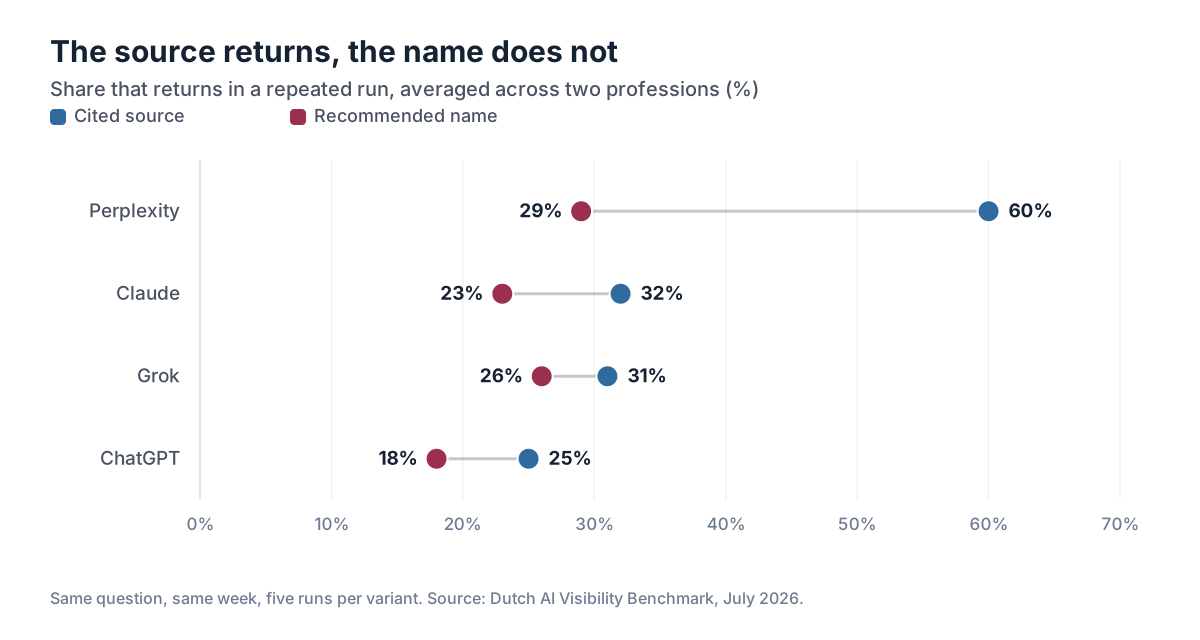
- The name churns even harder than the source. On Perplexity, around 60 percent of the sources returned in a repeated run. Of the recommended names, less than a third did. The model goes back to the same place and fishes out a different name each time.
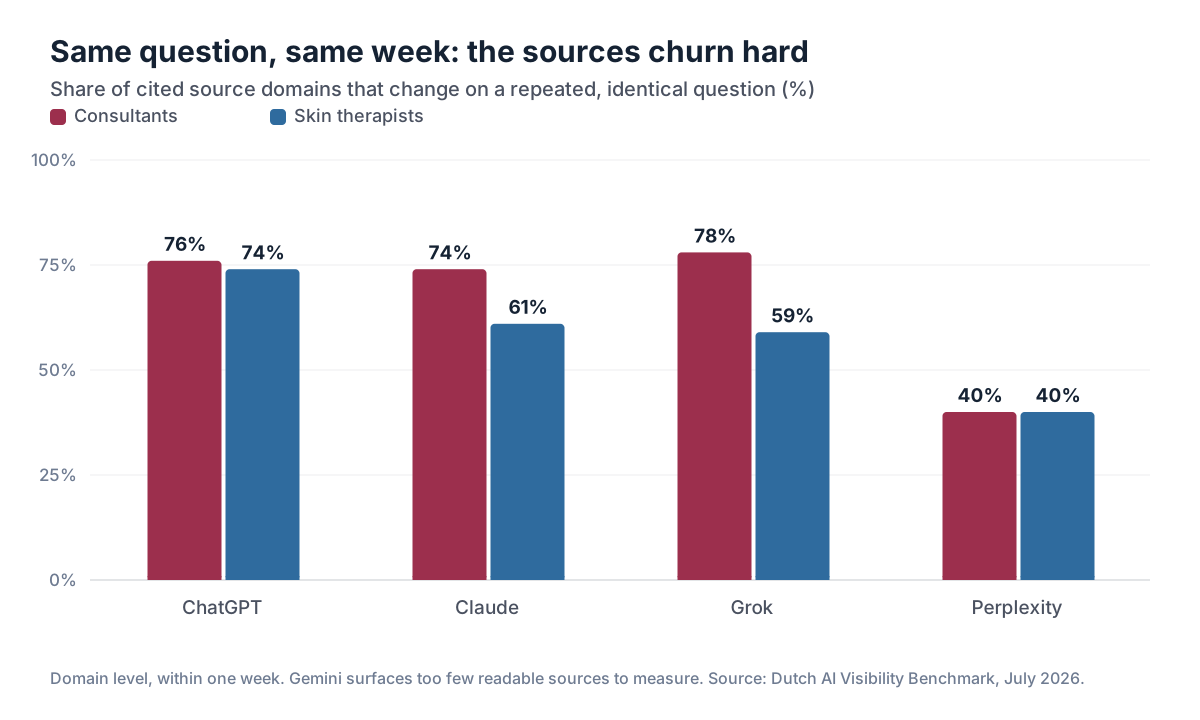
That second point is the wedge. Being in the source is the ticket to play at all. Which name the model then pulls out is a second decision, and that is exactly the layer that wobbles. Findability gets you to the door. What happens after that is decided somewhere else.
The Dutch Citation Core
Semrush describes a "Citation Core" per country: the small group of sites all AI assistants tend to trust and cite by default within an industry. They publish cores for the US, the UK and Germany. A Dutch one existed nowhere. We built it from our citation data, per profession, and the shape differs sharply.
- Skin therapists: a mature core. ZorgkaartNederland, the Dutch healthcare review site, returns on all five AI assistants. Around it: the professional register at huidtherapie.nl, the medical reference thuisarts.nl and the booking site Treatwell. Here AI leans on a mature external infrastructure of registers, review sites and medical references.
- Consultants: a thin core. One trade hub (consultancy.nl), LinkedIn, and a few niche registers. Beyond that, AI falls back on the experts' own websites, because the external scaffolding is largely missing.
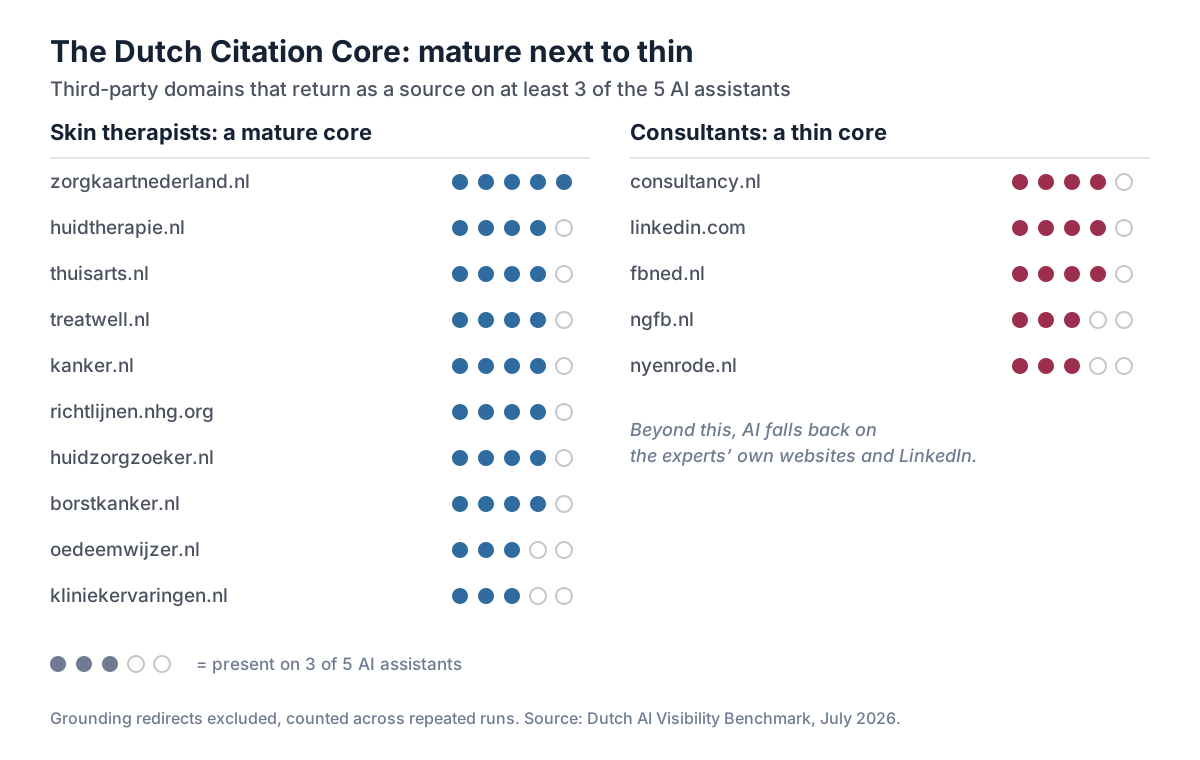
The lesson is the same in both fields. It is a small, fixed set of sources. Being consistently and unambiguously present in that set is the lever. Yet another blog series on your own domain changes little about it.
The third layer
The three blocks of evidence point the same way. Findability, which is what GEO and SEO are both about, gets you into the Citation Core, the small fixed set of sources the model trusts. Within that core, the source is more stable than the name that comes out of it: the model returns to the same place and pulls out a different party each time. And at macro scale it rewards the parties that send a consistent, coherent signal about who they are, everywhere. So beneath GEO and SEO sits a third layer, and it is about identity.
We tried to capture that layer in numbers. For 114 Dutch experts in five professional fields, we mapped which online characteristics go together with being mentioned by the five major AI assistants. Every characteristic (own domain, structured data, Wikidata, LinkedIn activity, trade media mentions, consistency across sources) was recorded per person with source references, so the judgment can be checked. The honest picture is nuanced. At first glance, a Wikidata item, an active LinkedIn profile and entity consistency seem strongly associated with being mentioned. Most of that association turns out to be a field effect: architects carry nearly all of the Wikidata signal and also happen to be mentioned most often. Correct for field, and most of the associations collapse. Within a single field, no single signal cleanly separates the mentioned experts from the invisible ones. There are architects with a Wikidata item and eight trade media mentions who remain completely out of sight.
One characteristic survives that correction: entity consistency. Do name, practice and field paint the same picture across all sources? That is precisely the coherence from the Semrush research, now found again at the level of individual people in Dutch niches. The link remains associative and the sample is small, so read it as direction. But it points the same way as the macro measurement: whoever exists as one recognizable entity more often becomes the party the model pulls out.
The sharpest pattern is in how experts surface. In some fields AI names the person, in others the brand. In our measurement, skin therapists came up as a clinic or practice name without exception. The practitioner was never mentioned by name. For therapists and photographers it is the other way around: there, the person is the entity. The level at which the model holds on to your identity differs per field, and you only partly get to choose it.
Honest about these numbers
- Measurement window: mid 2026. The reported model version is logged per answer.
- We measure through the providers' APIs. Results in the consumer apps can differ.
- Source churn is measured at domain level. That is a lower bound; at URL level it comes out higher.
- Gemini cites barely any readable sources (most hide behind grounding redirects); the stability numbers therefore cover ChatGPT, Claude, Grok and Perplexity.
- Everything in this article is correlation. Causation cannot be proven with this design.
- The sample is small. Read percentages as direction and order of magnitude; exact numbers shift per measurement round.
What you can do with this tomorrow
A good part of the conclusion you can pick up yourself, without an agency and without us:
- Find the Citation Core of your field. Ask the AI assistants themselves which sources they use for a buying question in your field. Are you in those sources? With the same name, the same field, the same location as on your own site?
- Check at which level your field is remembered. Ask an AI assistant for recommendations in your field and see whether people or practice names come back. That tells you where your identity needs to converge: on your own name or on your practice's.
- Align your own footprint. Site, LinkedIn, registers, review profiles, mentions: the same name everywhere, the same description of what you do, for whom. Every stray variant dilutes the signal.
Whoever works in a field with a mature core and only needs to update their register entries is done in an afternoon. Do that first.
Where Identity First Media stands in this story
This benchmark is our own research. We publish it because our work sits exactly on that third layer. Identity First Media starts from who an expert already is, captures that as one fixed point, and builds the complete online presence around it: website, blog, newsletter, podcast and socials, from one weekly recording, in the expert's own voice. Because everything comes from that same source, the story can barely diverge across sources anymore. Coherence then is not a discipline you maintain by hand. It is a property of how your presence is put together.
That comes with honesty about who this works for.
Who this is for. Established experts: a few years or more in the field, real clients, a track record that registers, trade media and review sites can record something about. The data above shows why that is the precondition. Consistency is something you surface in what already exists.
Who this is not for. Starters without a track record: there is no identity with evidence around it to make coherent yet, and nothing changes that faster than the work itself. Also unsuitable for anyone who wants to buy visibility as a standalone product. Nobody can guarantee AI mentions, neither can we; everything in this research is correlation, and we say so with every publication. And whoever only needs to fix their Citation Core entries can, as said, do that themselves.
The question under the question
GEO vs SEO is a fight over the same layer: how findable your publications are. That layer stays necessary, because without presence in the sources you are not in the game. But it is the door, and we spent too long thinking it was the whole house.
How well your site is doing is the old question. The new question: does the rest of the internet tell the same story about you that you tell yourself? As long as the answer is no, the model keeps fishing someone else out of the same source, and the right people find you later than they should.
Want to know what that looks like for your name? Take the free scan (14 questions, five minutes) or book an introductory call. Either way you get an honest answer. Even if that answer is that you can do it yourself.